4. Pavel Filonov 1883 – 1941
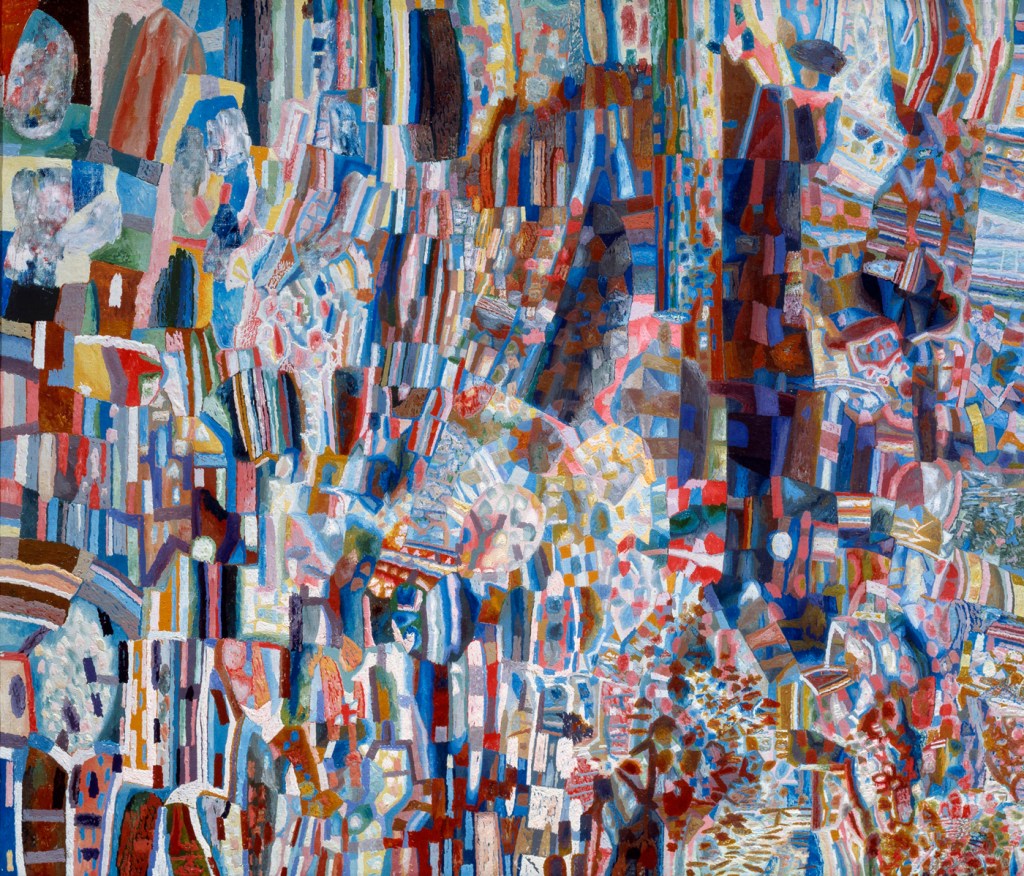
‘Composition’ 1929
Pavel Nikolaevich Filonov was a prominent Russian art theorist, painter. He was born on January 8, 1883 in Moscow.
He initially studied in the studio of academician L Dmitriev-Kavkazsky for five years and in 1908, aged 25, entered the St. Petersburg Academy of Arts.
In 1912, he published an essay ‘The Canon and the Law’ in which he expounded his ideas on ‘Analytical Realism’, which represented the inner soul of objects as opposed to ‘Cubism’, which represented the geometric surface of subjects.
In 1916 the First World War broke out and Filonov enlisted and served on the Romanian front. His experiences there led him to be an active member in the Russian Revolution of 1917.
After the revolution the government started to dictate its own interpretation of the arts and literature, in particular it promoted ‘social realism’. Filonov’s theory of art did not meet those principles and as a consequence his works were never acknowledged.
In 1923 served as a professor at the St. Petersburg Academy of Fine Arts and he organized the school of Master of Analytical Realism, which eventually had up to seventy members.
Filonov’s paintings were very detailed and seemingly abstract to a very high degree. But, although an enigma to the spectators, his depiction of man-made and natural objects were highly synthesized with those of figurative subjects, resulting in complex images, all connected, but with hidden and symbolic meaning. These works are stunning, and full of colour and intrigue that attract the viewer, even though they cannot interpret the encrypted meanings.
Filonov rarely made money from his paintings, as he refused to sell them to individual patrons. He hoarded his paintings rather than sell them. His ultimate desire was to gift them all to the Russian Museum so they could start a Museum of Analytical Realism. This left him destitute during the last few years of his life until his death, along with 1.5 million people, who died of hunger during the siege of Leningrad in 1941.
His wishes were granted, after his death, when his sister gave his paintings to the Russian Museum.
 Paul Vachon