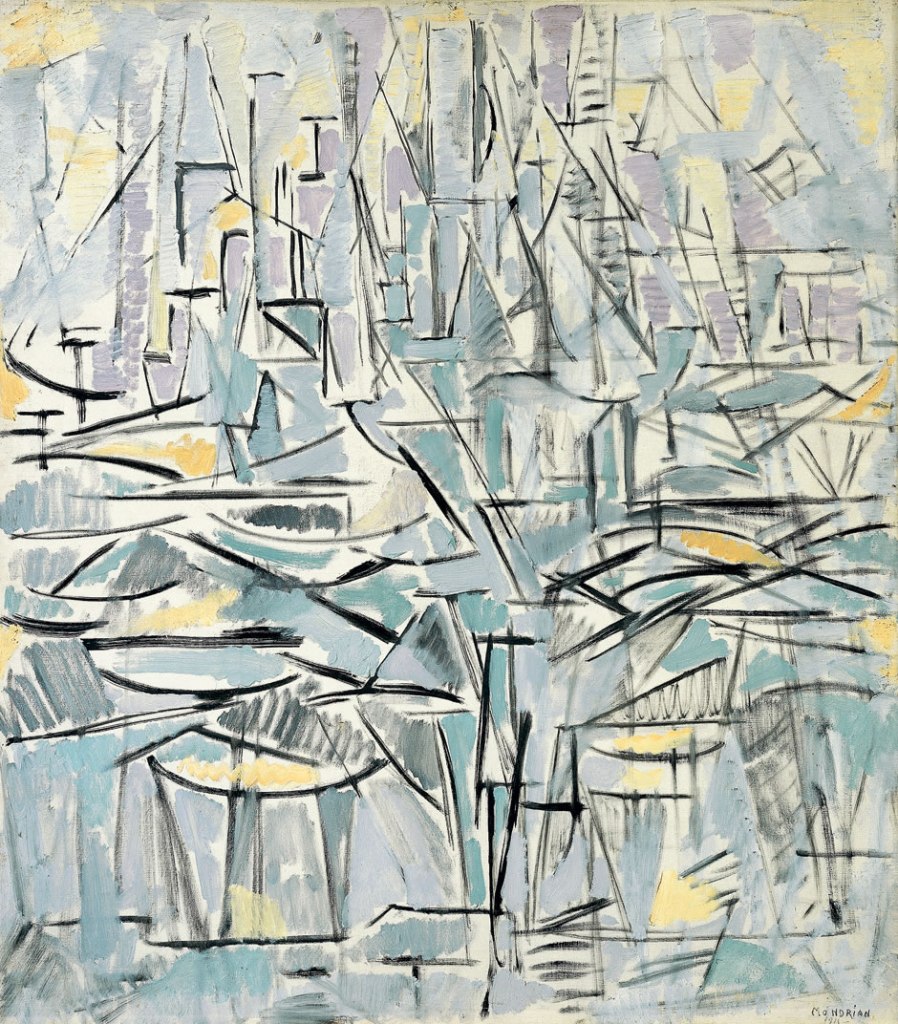
2. Piet Mondrian (1872 – 1944)
‘Composition XVI’
Of course the name Mondrian conjures up the image of regimented black lines and primary colour block paintings. They have become synonymous, and almost a cliché, with anything modern.
At the time he painted these they must have been completely bewildering and alien. But they didn’t just appear out of nowhere – they evolved over many years as Mondrian struggled to develop a unique theory and style of his own.
His early works were very traditional and figurative. He sold very few during the early years – his income was from copying other works and from producing botanical drawings.
He seems to have been influenced, firstly by Van Gogh, for colour and vibrancy, and then by the Cubists, Picasso and Braque. And his work started to lean towards abstraction. This is first seen in a series of tree paintings around 1911. The emphasis shifts from the structural form of the tree to the negative spaces between the trunk and branches. He kept on developing the relationships between the lines and spaces and reducing them to the simplest form. The titles of his works changed from descriptive names to compositions.
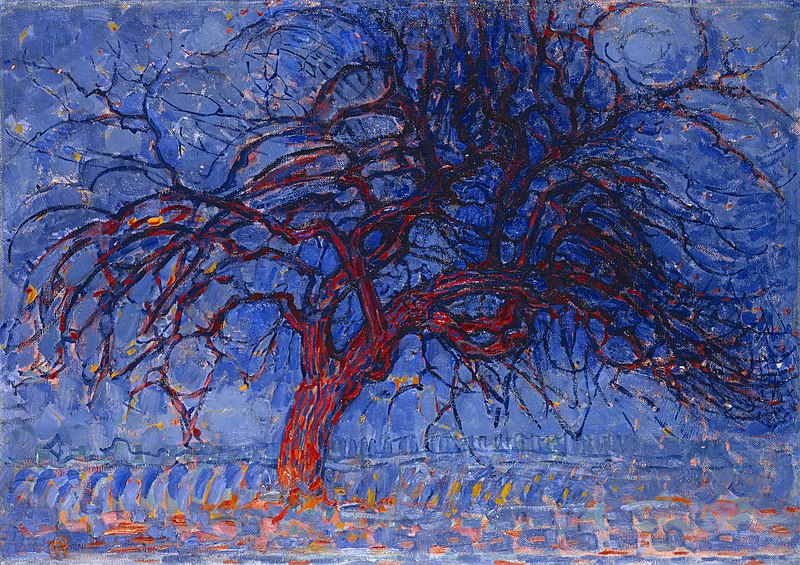
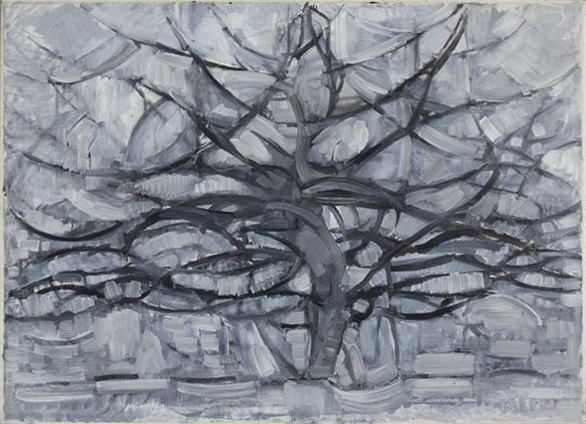
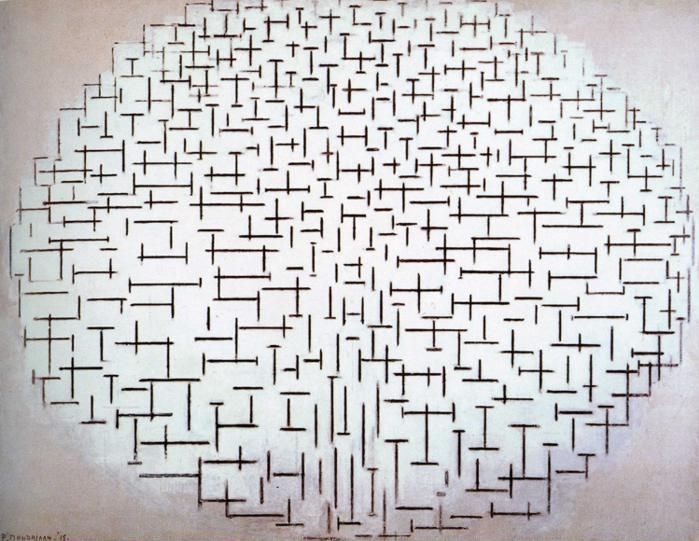
By the 1920’s his works were now at their optimum of abstraction.

Mondrian liked order in his life and the precise line and colour, meticulously painted, suited his persona. More importantly, his works were now beginning to sell and his status as an original thinker and pioneer of abstract art was assured.
Composition XVI (Tree)
I like the line, weight , colour and form of Composition XVI – the title is suffixed with ‘Tree’ in brackets. But this is very much the essence of a tree without having that title. The lower branches depicted by stronger black lines along with uniform pastel colours fading to the topmost twigs give weight, distance and height. It still has figurative undertones but is very much a metaphor of the subject, and therefore abstract to my mind.
 Paul Vachon